How much does a fence cost in Savannah, GA? What about the price for materials and labor? Why does every fence cost guide give you a different number?
Every fence company, material, and size can lead to a different price when you are looking for Savannah fence costs. Try it yourself: just search chain link pricing right now, and you’ll turn up four credible 2026 sources quoting $8 to $40, $10 to $40, $29 to $45, and $32 to $71 per linear foot installed.
The same fencing material, same year, same country. One data set built on real installs says a typical job lands near $44 a foot, while another says the whole range tops out at $40, but what is the real price of a fence in Savannah?
Each fence price you find online reflects a different mix of jobs, regions, and specifications, then averages it into a single number that fits nobody’s actual yard. All jokes aside, we wanted to create a guide for fence costs in Savannah and Pooler for the everday person.
This page is one of those guides, so you can use it to help you as you pick out your new fence and budget for it!
Average Fence Cost in Savannah by Material
What we can add here at JG Fence Company is the local fence pricing; this is the line the national calculators don’t have. For accurate fence pricing, you need a local fencing company because they know the cost of materials, permitting, and other local factors.
Fence cost Savannah, GA homeowners can plan around comes down to material, total linear footage, height, gates, property conditions, and the kind of fence you actually want. Fence installation cost in Savannah, GA gets quoted per linear foot for good reason, but a per-foot figure is a planning tool. It is not a quote, and treating it like one is how budgets get broken.
Fence cost per foot in Savannah tracks national benchmarks reasonably well, and those currently put professionally installed fencing between $15 and $75 per linear foot across materials, with complexity pushing the top end higher (think a basic wood fence up to an elaborate steel fence).
| Fence Type | 2026 Planning Range* | 150 LF Example | 200 LF Example |
|---|---|---|---|
| Chain Link | $10–$40/LF | $1,500–$6,000 | $2,000–$8,000 |
| Wood | $20–$50/LF | $3,000–$7,500 | $4,000–$10,000 |
| Vinyl | $30–$60/LF | $4,500–$9,000 | $6,000–$12,000 |
| Aluminum | $25–$75/LF | $3,750–$11,250 | $5,000–$15,000 |
| Commercial | Varies significantly | Quote-based | Quote-based |
Here in Chatham County, the local variables that move your number are:
- Savannah soil and how deep posts have to go in it
- Coastal moisture working on materials and hardware
- Property access for equipment and materials
- Removal and disposal of the existing fence
- HOA requirements on material, height, and color
- Permits, which vary by which jurisdiction you’re in
- Gates, where cost concentrates fast
- Trees and root systems in established neighborhoods
- Uneven or unclear property lines
- Flood-zone documentation, including that engineer’s letter
Read that table as a planning tool, not a price list. These are general 2026 ranges drawn from current national installed-cost benchmarks, and they are not JG Fence Company quotes. What you actually pay in the Savannah area depends on material, height, layout, gate count, site conditions, and your project’s specifications.
The per-foot figures above line up with current 2026 HomeGuide estimates for each material.
How Much Does a Wood Fence Cost in Savannah?
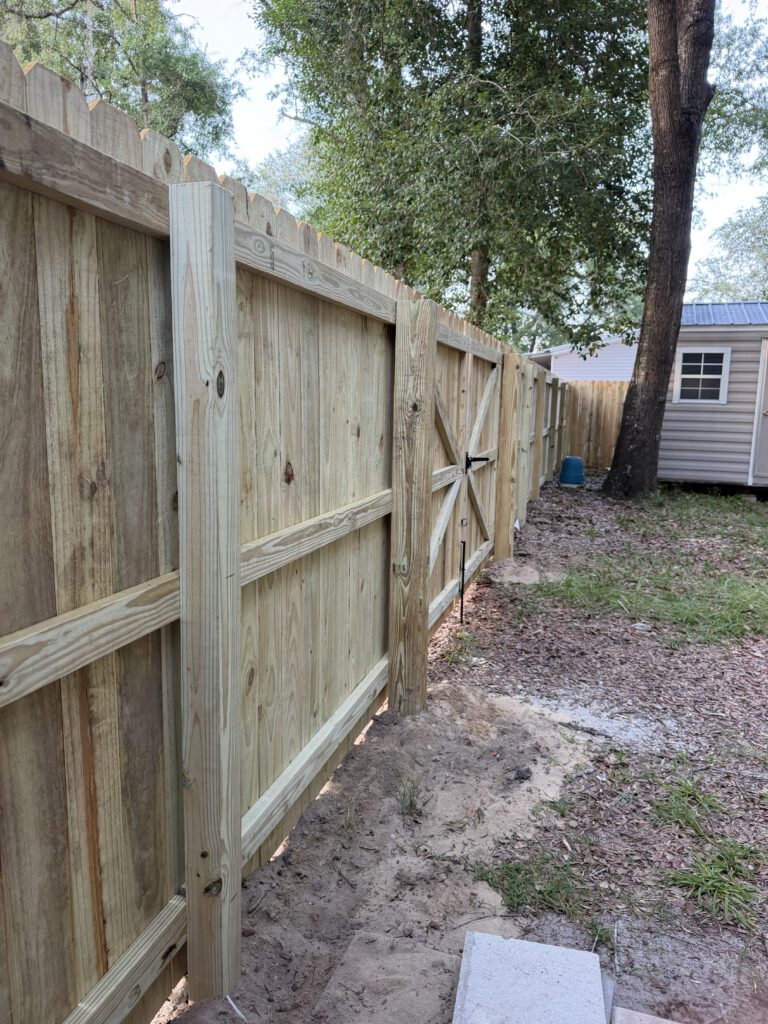
Wood fence cost in Savannah, GA tracks national installed pricing closely, currently running roughly $20 to $50 per linear foot. Wood remains the most common fence going up in Chatham County. A standard 6-foot privacy fence typically sits in the $25 to $35 range.
Some wood fences with specific designs or custom elements such as lattice, lights, or other add-ons can cost upward of $50 per linear foot.
What is the Average Wood Fence Cost by Linear Foot?
The average price for a wood fence per linear foot is between $25-$35.
Pressure-treated pine anchors the low end and accounts for most residential work here. Privacy fencing sits in the mid-range and is what most people picture. Picket fencing uses less material per foot but more labor per picket, so the savings are smaller than they look. Shadowbox costs more than standard privacy because boards alternate on both sides of the rail, which means more lumber for the same run.
Horizontal fencing has become popular and costs more than traditional vertical because the boards span between posts without intermediate support, so the lumber has to be better and the posts closer together. Decorative tops, lattice caps, and scalloped runs add labor, not material. Fully custom wood fencing sits wherever the design puts it, which is why nobody quotes it from a chart, but instead a custom consultation.
What makes a Wood Fence more expensive?
Not every fence is created equally, which means you might see a difference in the price of your stockade or board-on-board wood fence depending on the following factors:
- Height of Fence: Moving from 6 feet to 8 feet adds material and usually requires deeper, larger posts
- Board-on-board construction, where overlapping boards eliminate gaps and consume noticeably more lumber
- More lumber generally, whether from tighter picket spacing or heavier stock
- Larger posts, especially 6×6 rather than 4×4 at gates and corners
- Decorative caps and trim on every post
- Multiple gates, each one framing, hardware, and labor
- Staining or sealing at install rather than leaving it raw
- Difficult terrain, since slopes require racking or stepping
- Removing the existing fence, which is labor plus disposal fees
Example: Cost of a 150-Foot Wood Privacy Fence
What does a 150-foot wood fence cost in Savannah? Run the benchmark math, and 150 linear feet at $20 to $50 lands between roughly $3,000 and $7,500.
That’s a wide window, and where you fall in it is predictable. A straightforward pressure-treated pine fence on flat, accessible ground with one walk gate belongs near the bottom. Taller construction, board-on-board, decorative tops, multiple gates, a slope, or an old fence that has to come out first will push you toward the top or past it.
How Much Does a Vinyl Fence Cost in Savannah?
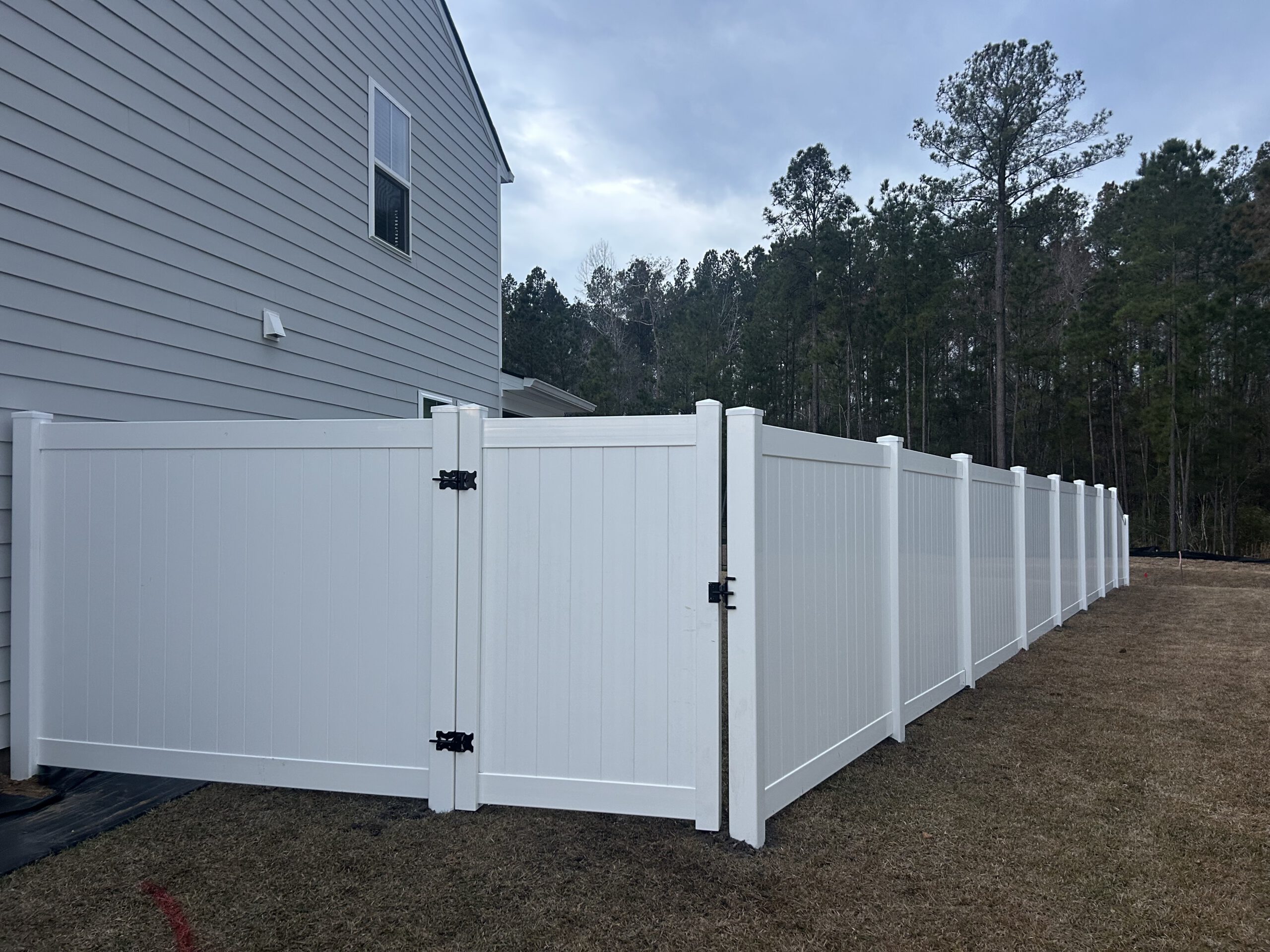
Vinyl fence costs in Savannah, GA start higher than wood. National installed pricing currently runs about $30 to $60 per linear foot. Six-foot vinyl privacy installations commonly sit in the upper portion of that range and climb further with height and style.
Why Does Vinyl Cost More Than Some Wood Fences?
You’re buying a manufactured system rather than a pile of lumber, and every component arrives engineered.
Panels arrive as engineered assemblies, not loose boards. Posts are extruded to spec and frequently reinforced with an internal insert at gates and corners, and rails lock into routed posts rather than getting nailed on. Caps are molded parts. Gates come as assembled units with their own hardware. Material quality varies more than people expect, and wall thickness is where cheap vinyl gives itself away within a few summers.
The reinforcement matters most in gate posts, which take the entire swinging load. All of that costs more upfront than pine and rails. What you get back is a fence with essentially no maintenance requirement, and over fifteen years that changes the arithmetic considerably.
Example: 150 Feet of Vinyl Fence
At $30 to $60 per linear foot, 150 feet works out to roughly $4,500 to $9,000 before gates and site-specific extras.
Is Vinyl Worth the Extra Cost in Savannah?
It makes a strong case here, though not a universal one.
Savannah’s humidity and rainfall are hard on wood. Vinyl doesn’t absorb moisture, so it won’t rot, cup, or feed insects, and it never needs staining or sealing. Cleaning is a garden hose and occasionally soap. Over a fifteen-year horizon, the staining schedule a wood fence demands closes much of the initial price gap.
Where vinyl loses the argument: if you want a natural wood look, if the fence is a short run where the maintenance savings are small, or if the budget genuinely cannot stretch. Both materials work in this climate. Vinyl just asks less of you afterward.
How Much Does Chain-Link Fencing Cost in Savannah?
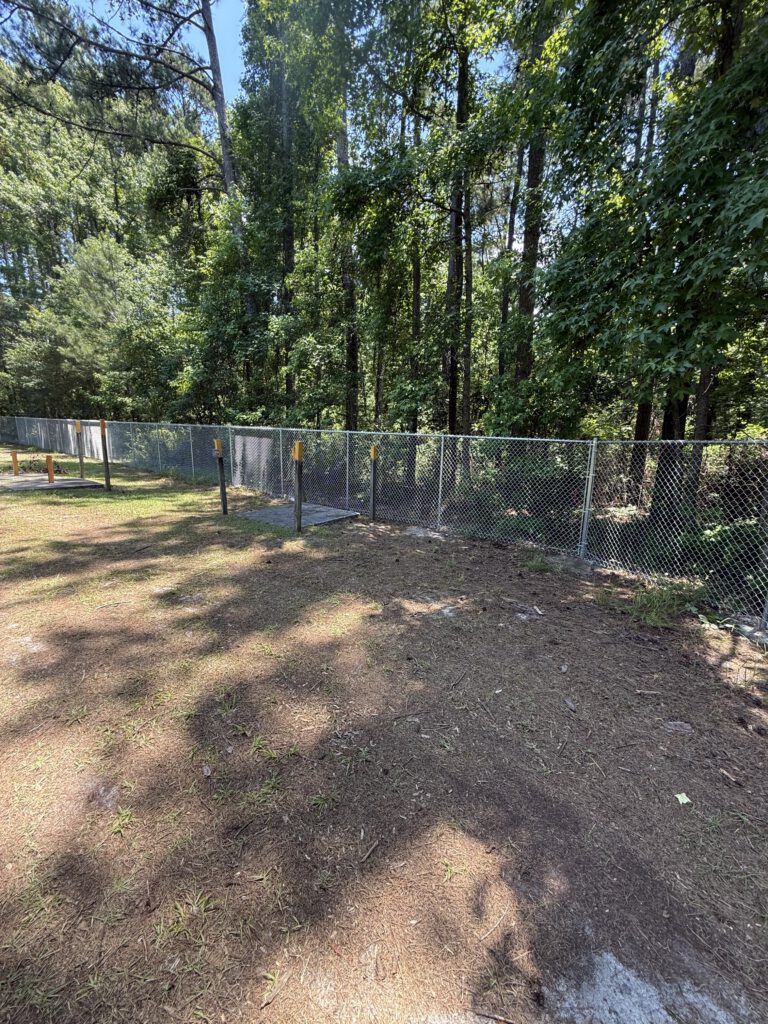
Chain link fence cost in Savannah, GA starts lower than any other material here. National installed averages currently run around $10 to $40 per linear foot, and that range covers three fairly different products.
Galvanized Chain-Link Fence Cost
The standard configuration and the lowest-cost option on this page.
Height drives the price. A 4-foot fence is common along front yards and side yards and sits at the bottom of the range. A 5-foot run splits the difference and suits dog containment where a 4-foot fence won’t hold a jumper. A 6-foot fence is the usual choice for backyard enclosure and security work, and it lands toward the upper end because taller fabric means heavier posts and more concrete.
Black Vinyl-Coated Chain-Link Fence Cost
Coated chain link currently runs approximately $10 to $34 per linear foot in national installed-cost estimates, which puts it above galvanized for a reason people find worth paying.
Appearance is the main one. Black chain link visually recedes against a treeline or a hedge in a way bare galvanized never manages, which makes it far more acceptable in residential yards. It works well for dog runs where you want containment without a visual wall, and along property boundaries where a solid fence would feel unneighborly. The coating also adds a corrosion barrier over the galvanizing underneath, which matters in salt air.
Commercial Chain-Link Fence Cost
Commercial-grade chain link costs substantially more than a residential run, and the gap comes from the specifications rather than the markup.
Heavier fabric gauge, taller runs of 8 feet and up, larger-diameter posts, and heavier rail all add material. Security features add more: barbed wire arms where appropriate and permitted, tension wire, and heavier gate hardware. Gates on commercial sites are frequently wide enough for equipment, which changes them from a hardware item into a fabrication item.
One current contractor benchmark places commercial-grade chain link around $24 to $38 per linear foot, which illustrates the distance from a basic residential configuration. That’s a national figure and not a JG Fence Company price for your site.
How Much Does an Aluminum Fence Cost in Savannah?
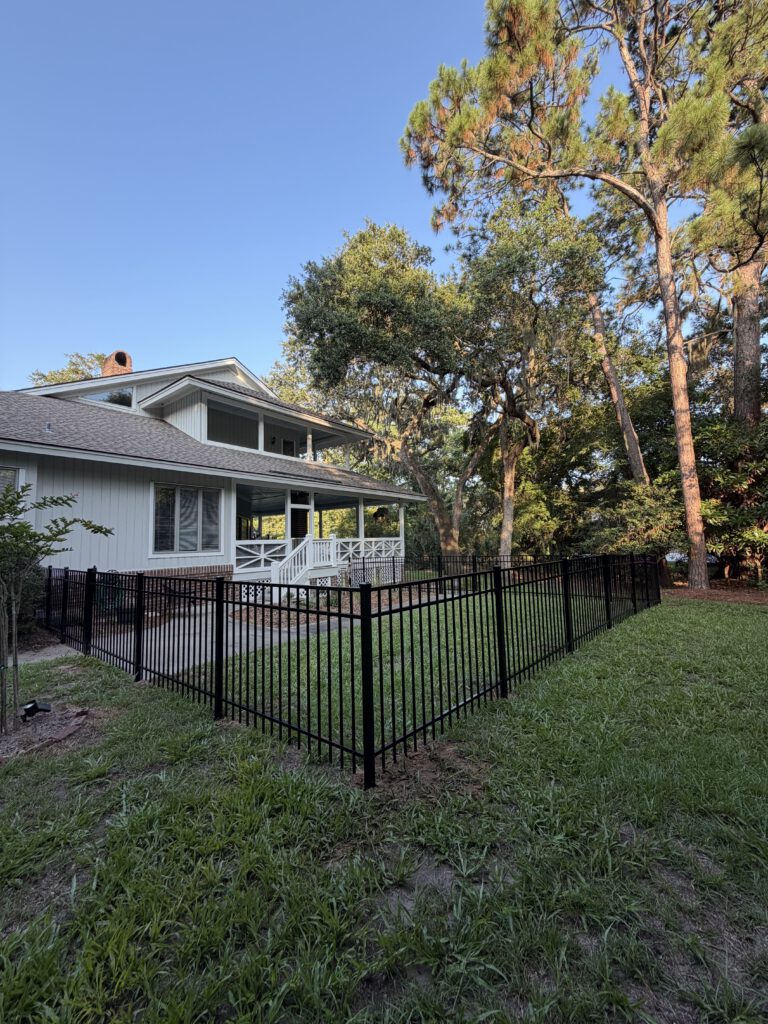
Aluminum fence cost in Savannah, GA runs roughly $25 to $75 per linear foot installed at current national pricing, the widest spread of any material here because the category covers a basic 3-foot garden picket and a 6-foot ornamental commercial perimeter.
Standard Aluminum Fence Cost
Basic picket aluminum occupies the lower half of the range. National estimates put aluminum picket fencing around $25 to $50 per linear foot installed, with the number of rails and the picket spacing driving where you land.
Ornamental and specialty configurations cost more. Spear-top, pressed-point, and decorative styles add fabrication. Solid aluminum privacy panels are a different product entirely and cost far more than standard picket.
Pool Aluminum Fence Cost
Pool fencing costs more than the same-looking fence elsewhere on the property because of code, not appearance.
Safety requirements drive it. Height minimums, picket spacing tight enough to stop a small child, restricted ground clearance, and gates fitted with self-closing hinges and self-latching hardware positioned out of reach all add material and labor. Chatham County requires a fence around pools 24 inches or deeper, so this isn’t optional if you’re putting in a pool. Confirm current requirements with your permitting authority before fabricating anything, because a barrier that fails inspection is a barrier you pay for twice.
Puppy-Picket Aluminum Fence Cost
Puppy picket adds a third rail low on the panel with tighter spacing near the ground, typically under 3 inches between pickets, so small dogs can’t walk through.
It costs more per foot than standard picket because you’re buying more aluminum in the same panel. For anyone with a dachshund, a terrier, or a puppy that hasn’t finished growing, it’s cheaper than discovering the gap the hard way.
Why Savannah Homeowners Choose Aluminum
The maintenance case is the strongest one. Aluminum doesn’t rust the way steel does, which matters near the marsh and the river. It handles a coastal environment better than most metals; it’s the default around pools because it secures the area while keeping the water visible, and it keeps sightlines open where a solid fence would close in on a yard.
The decorative appeal is real too, and you don’t have to plan around wood rot.
Two honest caveats about aluminum fencing. One, aluminum is highly corrosion-resistant, not immune, and in Coastal Georgia the finish and the hardware matter. Hinges, latches, and fasteners fail years before the pickets do, so specify grade on the estimate rather than accepting whatever ships in the box.
How Much Does Commercial Fencing Cost in Savannah?
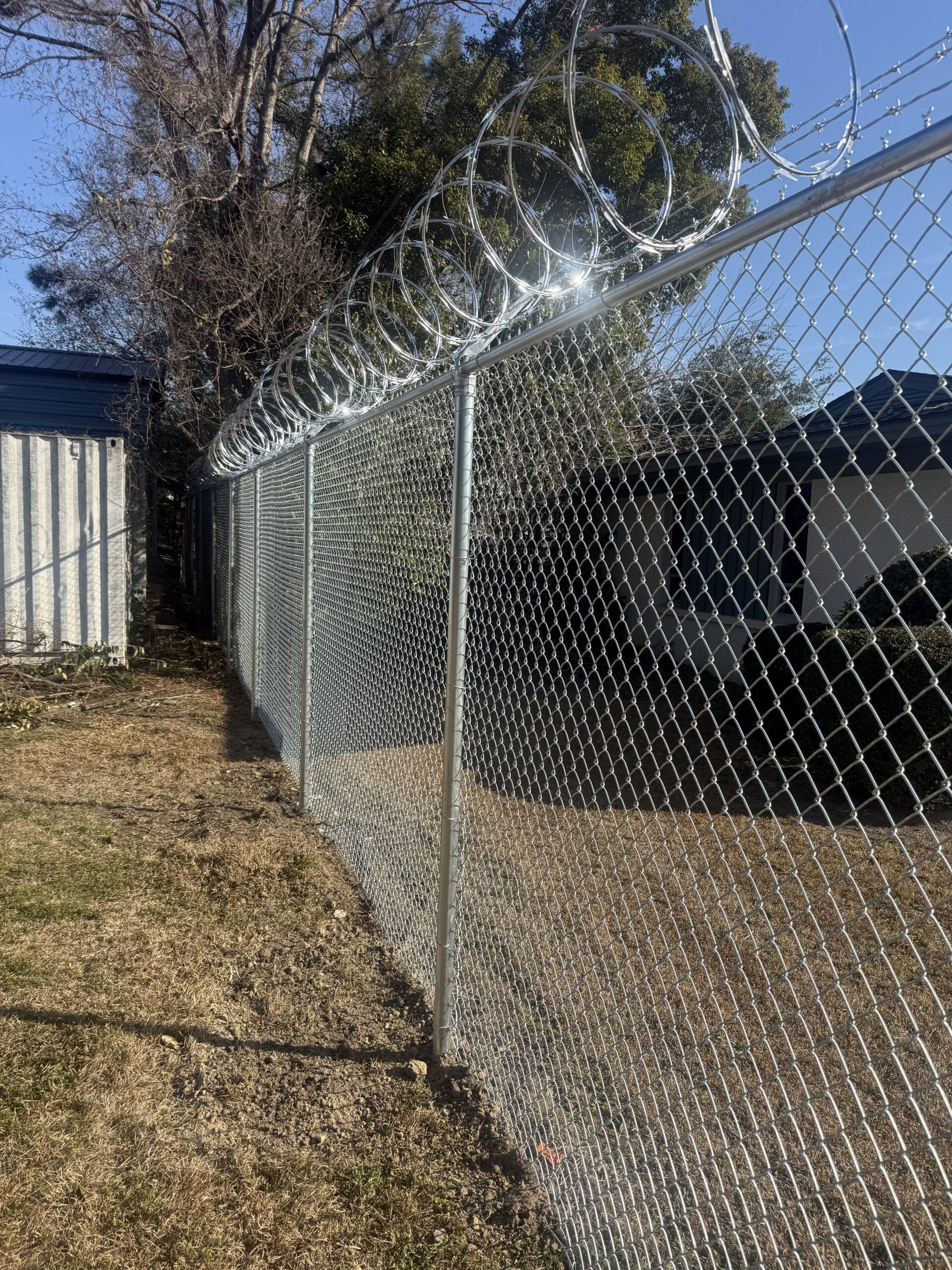
Commercial fence cost in Savannah, GA resists a single number, because the category isn’t one product.
Commercial fence pricing swings substantially depending on whether a property needs basic chain-link perimeter fencing, ornamental aluminum at the street, wood or vinyl privacy screening, security fencing, access gates, or a combination of these, each with different specifications across a site. Security fencing in particular spans an enormous range depending on the level of protection and the system specified, so a single universal price per foot would mislead more than it helps.
Commercial Chain-Link Fence Pricing
The specification drives everything. Height, often 8 feet or more. Fabric gauge, where heavier wire costs more and lasts longer under abuse. Post diameter and wall thickness, which is where cheap commercial fence fails first. Coating, galvanized or vinyl-coated. Security features layered on top, from barbed arms to tension wire to anti-climb configurations.
Commercial Aluminum Fence Pricing
Ornamental aluminum shows up where the property needs to look good. Office buildings, multifamily communities, HOA common areas and entrances, pool enclosures at apartment complexes, and decorative perimeter runs along a street frontage.
Commercial-grade aluminum uses heavier posts and wider panels than residential, so it prices above the residential ranges quoted earlier.
Commercial Privacy Fence Pricing
Wood or vinyl, depending on the application and how long it needs to last. Wood screening around a dumpster enclosure or an equipment yard is economical and replaceable. Vinyl costs more upfront and holds its appearance without a maintenance line in anyone’s budget, which matters on a property nobody will stain every few years.
Commercial Gates and Access Points
Gates change a commercial quote more than any other single element, and often by more than the fence itself.
A pedestrian gate is straightforward. A double-drive gate wide enough for a truck is a fabricated assembly. A cantilever gate, which rolls without a track across the opening, costs considerably more and needs the runway space beside the opening to do it. Automated gates add an operator, a power supply, safety loops, and photo eyes. Access control adds card readers, keypads, or telephone entry on top of that.
None of that belongs inside a cheap per-linear-foot estimate, and any quote that buries gate automation in a per-foot number is hiding something.
What Does a 100-Foot Fence Cost?
| Fence | Approx. 100 LF Planning Range |
|---|---|
| Chain Link | $1,000–$4,000 |
| Wood | $2,000–$5,000 |
| Vinyl | $3,000–$6,000 |
| Aluminum | $2,500–$7,500 |
How Much Does a 150-Foot Fence Cost?
| Fence | 150 LF |
|---|---|
| Chain Link | $1,500–$6,000 |
| Wood | $3,000–$7,500 |
| Vinyl | $4,500–$9,000 |
| Aluminum | $3,750–$11,250 |
How Much Does a 200-Foot Fence Cost?
| Fence | 200 LF |
|---|---|
| Chain Link | $2,000–$8,000 |
| Wood | $4,000–$10,000 |
| Vinyl | $6,000–$12,000 |
| Aluminum | $5,000–$15,000 |
These are the cited national per-foot ranges multiplied by footage, before any project-specific extras. Gates, removal, terrain, and access all sit on top.
What Factors Affect Fence Installation Cost in Savannah?
1. Total Linear Footage
More footage means more material, more posts, more concrete, and more labor hours. It does not scale perfectly, though, and the reason surprises people. Getting a crew, a truck, and equipment to your property costs roughly the same whether the run is 80 feet or 180. That fixed mobilization expense spreads across fewer feet on a small job, which is why a 60-foot side yard often prices higher per foot than a full perimeter. Measure your actual run before you assume a short fence means a small invoice.
2. Fence Height
A 4-foot fence, a 6-foot fence, and an 8-foot fence are three different projects wearing the same name. Each step up adds material across the entire run, and taller panels catch more wind, which means deeper holes, larger posts, and more concrete underneath. Current privacy-fence benchmarks show the jump from 6 feet to 8 feet producing a particularly steep increase, well beyond the extra third of lumber you might expect. If your covenants allow 6 feet, going to 8 is a choice worth pricing before you commit to it.
3. Fence Material
Chain link is usually the lowest upfront. Wood occupies the middle. Vinyl and aluminum sit higher depending on style and grade.
Those categories overlap far more than the ordering suggests, and treating them as fixed tiers will mislead you. A tall board-on-board wood fence can outprice a basic aluminum picket run without much effort. Commercial-grade chain link can outprice residential wood. A 4-foot vinyl picket costs less than a 6-foot cedar privacy fence. Configuration beats category almost every time, which is why comparing two quotes on material alone tells you very little.
4. Number and Size of Gates
Every gate is framing, hardware, hinges, latches, and labor concentrated into a few feet of opening, which makes gate count one of the sharpest levers on your total. A walk gate is modest. A double gate costs several times that, since it needs a drop rod, a center stop, and posts sized to carry two swinging leaves. A drive gate wide enough for a trailer is a different item again. Custom gates get priced as fabrication rather than as fence, and they should be quoted as their own line.
5. Removing an Existing Fence
Demolition and disposal are frequently a separate charge, and they are frequently the line quietly missing from the lowest quote you receive. Old posts set in concrete take real effort to pull, and the footings come out as heavy debris that somebody has to load and pay to dump. A chain link fence comes down faster than a wood privacy fence with 40 posts in the ground. Ask directly whether removal and haul-away are included, and get the answer in writing in the estimate rather than agreeing on the phone.
6. Trees, Roots and Landscaping
Established Savannah neighborhoods are full of mature trees, and their roots sit exactly where the post holes want to go. Working around a root system takes longer than digging clean ground, sometimes considerably longer, and cutting significant roots can kill a tree you specifically wanted to keep. Live oaks deserve particular care and may carry local protections on top of that. Beds, irrigation lines, and landscape lighting along the fence line all slow a crew down too, and every one of those hours shows up in labor.
7. Grade and Terrain
Slopes require either racking, where panels follow the contour of the ground, or stepping, where each panel stays level and drops in increments down the grade. Both take meaningfully longer than a flat run, because every post has to be measured against the one before it rather than set to a uniform height. Stepping also leaves triangular gaps at the bottom, which matters if you’re containing a small dog and may require additional fill or a bottom rail. Not every panel system racks, so the terrain can dictate your material.
8. HOA Requirements
Covenants routinely specify materials, heights, colors, and styles that cost more than what you would have chosen on your own. An association requiring a particular stain, a specific picket profile, black aluminum rather than galvanized chain link, or the finished side facing the street will move your number, sometimes by a lot. Some also require a stamped survey with the application. Finding any of this out after the estimate is written wastes everyone’s time and usually means re-quoting the whole job from scratch.
9. Permitting
Permit costs and requirements depend on which jurisdiction governs your address, and in Chatham County that is genuinely not obvious from the mailing address alone. Unincorporated county, City of Savannah, and the incorporated municipalities each run their own process with their own fees and timelines. Historic district properties add a Certificate of Appropriateness through the MPC, which runs on its own calendar. Flood zones add an engineer’s letter.
Our Chataham Fence guide explains which authority applies to your property and what each one requires.
10. Coastal Conditions
High humidity, heavy rain, standing moisture, and salt exposure near the water call for specific materials, hardware grades, and installation methods. Savannah averages roughly 48 inches of rain a year, with August alone bringing about 8.4 inches, so drainage around posts affects how long a fence lasts more than almost any other decision you can make. Storm and wind loading shapes post depth, spacing, and panel design. None of that automatically raises the price, but it does change what a properly built fence looks like here versus one built inland.
Does a Fence Cost More in Savannah Because of the Coastal Climate?
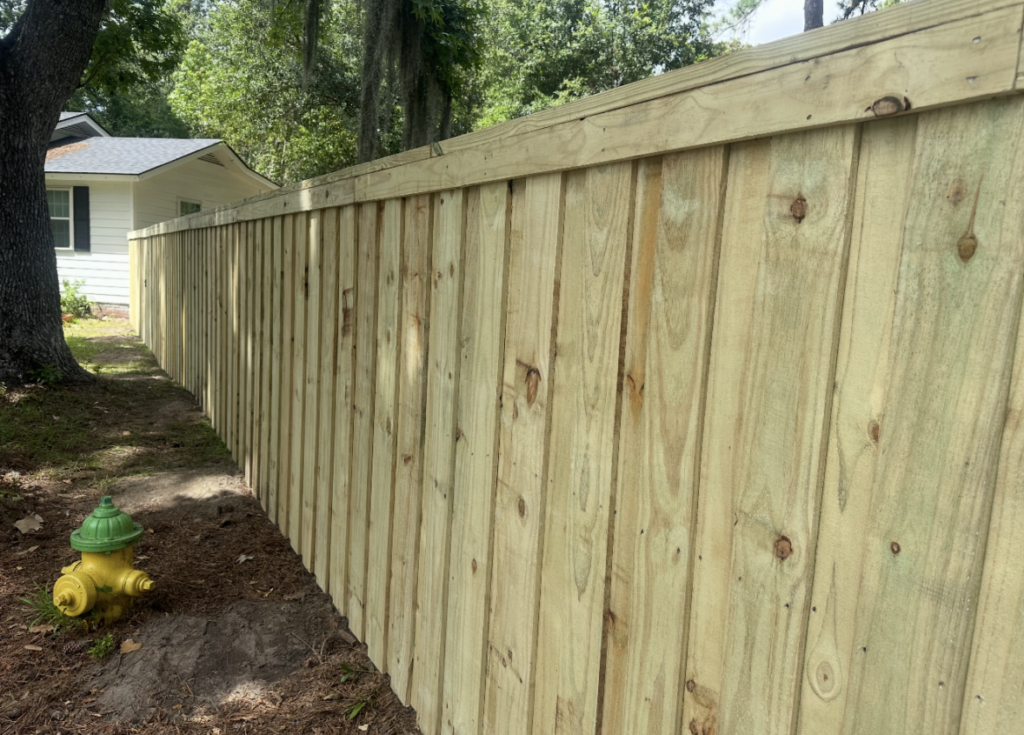
Not automatically, and not simply because of the address. Coastal conditions influence the right material, hardware, and installation method more than they inflate the total.
Where they do show up in a quote: properly treated lumber rated for this exposure rather than the cheapest stock on the rack. Corrosion-resistant fasteners and hardware, which cost more and are the single best money you’ll spend out here. Aluminum specified where salt air would eat steel. Quality coatings on chain link and metal components. Proper drainage around posts, which sometimes means gravel and a little extra labor.
Those choices raise the upfront number modestly and lower the long-term maintenance number substantially. A fence built for inland Georgia and installed on Wilmington Island is cheaper on day one and more expensive by year six.
Which Fence Is Cheapest in Savannah?
Chain link, generally, and it isn’t close. Current national estimates place chain-link fencing around $10 to $40 per linear foot installed, against roughly $20 to $50 for wood, $30 to $60 for vinyl, and $25 to $75 for aluminum.
Cheapest upfront and best value are different questions, though. Chain link gives you almost no privacy, which rules it out for most backyard projects, and it looks like exactly what it is across a front yard. If privacy is why you’re fencing, the cheapest fence on the list won’t solve your problem at any price.
Wood vs. Vinyl vs. Aluminum vs. Chain Link: Which Is the Best Value?
| Material | Upfront Cost | Maintenance | Privacy | Good For |
|---|---|---|---|---|
| Wood | $$ | Higher | Excellent | Privacy & traditional appearance |
| Vinyl | $$$ | Low | Excellent | Low-maintenance privacy |
| Chain Link | $ | Low | Low | Budget, pets, security |
| Aluminum | $$$ | Low | Low | Pools, curb appeal, visibility |
Value is a fifteen-year number, not an install-day number. A wood fence that needs staining every few years and board replacement along the way can end up costing more than the vinyl fence that looked expensive at signing. A chain link fence that does exactly what you need for twenty-five years is the best value on the list, regardless of what it cost.
Match the material to what the fence has to accomplish, then compare the long horizon.
How Can I Keep My Fence Project Within Budget?
The decisions that break a fence budget almost all happen after the estimate is written. Not every lever moves the same amount of money, though, and most advice on this treats them as equal. They aren’t close.
Fence cost tips that move thousands
- Footage. Walk the line with a tape before you call anyone. People routinely guess 40 percent off in either direction, and every foot is material, labor, and a share of a post.
- Material. On 200 feet, the gap between chain link and aluminum at the top of the range is five figures. Decide what the fence has to do before you decide how it should look.
- Height. Six feet to eight is not a third more fence. Deeper holes, larger posts, more concrete, more wind to fight.
- Gate count. Every gate is a small fabrication job. An extra walk gate “just in case” is real money for a door you’ll open twice a year.
Fence budget tips that move hundreds
- Customization. Decorative caps, cap-and-trim, custom stain. All optional, all pleasant, all adding up while you aren’t looking.
- Access. Say up front if a mini-skid can’t reach the back line. A crew discovering that on day one is a change order.
- Removal. Confirm whether pulling the old fence is in the quote and who covers the dump fee.
- HOA approval. Settle it before materials are ordered. Re-quoting a rejected design costs you a slot on the schedule, not just an afternoon.
Savings that aren’t savings
Shallow posts. Undersized gate posts. A 4×4 where the span wants a 6×6. Thin concrete, or none. Every one of those produces a lower number today and a leaning fence by year three, and then you pay for the same fence twice.
One rule for reading quotes
Compare the same fence, not the same bottom line. Insist on an itemized estimate, because a single lump number can’t be compared against anything. When one bid lands well under the others, the cause is usually a different height, a lesser material grade, a different post configuration, fewer gates, or a scope that leaves out removal. Line the specifications up side by side and the gap explains itself in the details rather than the margin.
What Should Be Included in a Fence Estimate?
A fence estimate should spell out every one of these, because a quote you can actually hold someone to leaves nothing to interpretation:
- Fence type and style
- Material and grade
- Approximate linear footage
- Height
- Number, width, and type of gates
- Removal and disposal of any existing fence
- Site preparation
- Installation scope
- Any project exclusions that apply
- Pricing, broken out rather than lumped
- Payment terms
An estimate missing half of those is a number with a logo on it.
Request a detailed fence estimate from JG Fence Company or call 912-657-3554.
The Number That Actually Matters Is Yours
Every figure on this page is a national benchmark. Useful for setting expectations, useless for writing a check.
Your fence has a specific length, a specific slope, a specific number of gates, and a specific old fence that may or may not need to be pulled out first. Somebody has to walk it before any of those become dollars.
We install and repair wood, vinyl, aluminum, and chain link across Savannah, Pooler, Whitemarsh and Wilmington Islands, Rincon, Bloomingdale, Guyton, Port Wentworth, Bluffton, and Hardeeville. Get a free estimate, and we’ll give you a number for your property instead of a national range.